Electrical grid failures have been pinpointed as sources of some of the country’s most damaging and deadly wildfires — the 2018 Camp and Woolsey fires in California, the 2020 Santiam Fire in Oregon and the 2021 Marshall Fire in Colorado. When the smoke dissipates, the cost of paying for these disasters hits utilities, and their customers, hard.
In the wake of the devastating fires, Nevada lawmakers passed legislation in 2019 requiring that the state’s primary electric utility — NV Energy — draft periodic plans outlining steps to prevent such a disaster from happening here.
In the years since, NV Energy has developed an extensive plan and invested millions of ratepayer dollars into mitigation efforts.
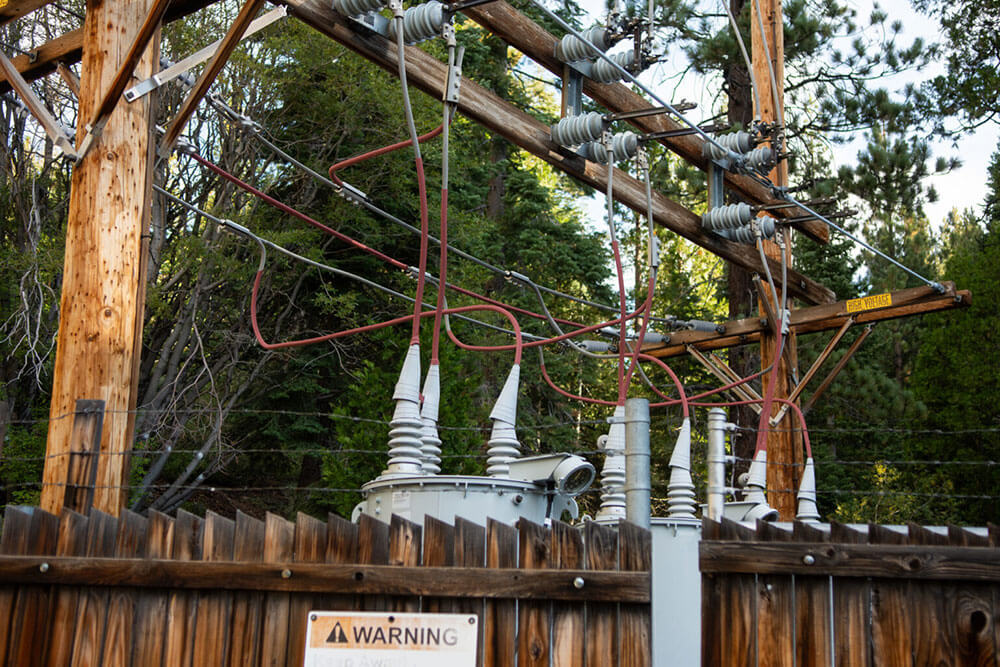
Amy Alonzo – An NV Energy substation in Incline Village on Oct. 2, 2023.
The latest NV Energy Natural Disaster Protection Plan (NDPP), which spans from 2024 to 2026, addresses preparation work for an array of disasters, including earthquakes, wind events, floods and mudslides, with the bulk of its focus on wildfires. The plan specifically targets nine areas of extreme or elevated fire risk ranging from Lake Tahoe to Elko. All but one of the targeted areas — in the Spring Mountain Range outside of Las Vegas — are in Northern Nevada, mostly in the Reno-Tahoe-Carson City area.
In the plan, NV Energy is forecasting $43.5 million for Southern Nevada projects, including wildfire cameras and moving lines underground, and $127.6 million for Northern Nevada.
Funding for the NDPP is collected from all NV Energy customers, without considering their geographic location. That geographic imbalance has led large corporate customers and the state’s consumer advocate to cry foul to the Nevada Public Utilities Commission (PUCN). They argue that slapping higher rates on all NV Energy customers — the majority of whom live in Southern Nevada, outside the highest risk zones — is not a fair solution.
Despite those protests, the PUCN this summer approved the newest plan and, with a 2-1 vote, the funding mechanisms for work done under the past plan. Rate changes go into effect this month.
Southern and Northern Nevada NV Energy customers pay different rates and base charges, including those for basic service and per kilowatt hour of consumption, but all customers, NV Energy argues, should be responsible for fire prevention because all customers benefit from natural disaster prevention.
The charges are nominal — a fraction of kilowatt hours used — for most residential customers. But for corporate power users such as gaming companies MGM Resorts International and Wynn Resorts — who have objected to how the plans are funded — the costs could be much higher because the NDPP and other volumetric surcharges scale up for large power users. Attorneys with the state’s Consumer of Bureau Protection (BCP) are also worried that ratepayers are funding direct costs outside of their service areas.
The multiyear battle raises an increasingly pressing public policy question as climate change fuels more erratic weather patterns: Are natural disasters statewide or local issues?
SB329 and the need for a natural disaster protection plan
In 2018, massive wildfires burned across the West. In California, the Mendocino Complex and the Carr fires burned hundreds of thousands of acres that summer; in November, the town of Paradise burned in the Camp Fire, killing 85 people and destroying more than 18,000 structures.
It was on the heels of those wildfires that former state Sen. Chris Brooks (D-Las Vegas) introduced SB329 during Nevada’s 2019 session.
The bill requires utility companies to submit a natural disaster plan to the PUCN every three years. Expenses related to paying for the NDPP would be recovered through a separate line item on customers’ power bills.
“The Camp Fire in California and similar events throughout the country have shown us that an improperly built electric grid can wreak havoc on residents,” Brooks said when presenting the bill. “We must prevent this from happening in our state.”
The response to natural disasters and the repair afterward is largely paid for by state tax dollars, and those are paid for proportionately across the state, Brooks said in a recent phone call with The Nevada Independent, adding that if the response and repair are paid for by all Nevadans, prevention should also be paid for by all Nevadans.
“It’s shortsighted to think wildfire doesn’t impact the whole state,” he said.
The bill passed in the Assembly 38-2, and unanimously in the Senate before being signed into law by former Gov. Steve Sisolak.
NV Energy submitted its first natural disaster plan to the PUCN in 2020 and its plan for 2024 to 2026 earlier this year.
The future and current disaster plans were approved without complaint — but the debate over who pays for the work done under the plans continues to rage.
Funding plans spark opposition
NV Energy collects funds from customers retroactively — with the approval of the PUCN — for work completed under the NDPP. Southern Nevadans will pay nearly $20 million for work completed last year in Northern Nevada, according to the BCP, and more than $67 million over the past four years.
Disaster prevention is a statewide benefit, the utility argues, citing language in SB329 for support. In 2020, lawmakers including Brooks wrote to the PUCN, clarifying that a single, statewide rate was the intent of the legislation.
“A single rate is exactly the cost-effective strategy and method the Nevada Legislature intended,” they wrote, adding that “Natural disasters, whether they be wildfires in Lake Tahoe or Mount Charleston, or a monsoon affecting the Las Vegas strip will affect the economy of the entire state.”
In a 2022 filing with the PUCN, NV Energy piggybacked off the sentiment of the letter, stating “most Nevadans will benefit from the NDPP.” It’s also pointed out that the charged NDPP rate “comprises a very small percentage of the average bill and will likely remain a small percentage of the average bill and will likely remain a small percentage in the future,” according to testimony provided by Cary Shelton-Patchell, NV Energy’s director of revenue requirement and regulatory accounting.
But the question of how rates are allocated across the state has been a recurring theme in regulatory filings, according to Jesse Murray, vice president of electric delivery and natural disaster protection for NV Energy, with the BCP and Southern Nevada gaming companies the primary objectors.
Large or small percentage, the BCP disagrees with the distribution of the NDPP charges across the state, stating that the payment by Southern Nevadans for work done in Northern Nevada “was ordered in the absence of substantial evidence to justify it.”
“To be clear, the BCP takes no issue with the NDPP in general,” attorneys for the agency said in a request for reconsideration. “The BCP takes issue with the decision to alter the reasonable and just premise that the cost causer pays.”
Whitney Digesti, senior deputy attorney general for the BCP, did not return a call to The Nevada Independent, and Ernest Figueroa, Nevada State Consumer Advocate and head of the BCP, did not respond to an emailed request for comment.
Leave a Reply