By Amy Alonzo
In the 19th century, the federal government, looking to boost railway construction across the relatively undeveloped West, offered railroad companies an incentive: Expand the rail lines and receive alternating sections of land along the railway corridor. The railway companies delivered, laying thousands of miles of track, and in return they received square-mile plots surrounding the tracks.
Decades later, portions of the West are a mishmash of public and private land. Known by the “checkerboard” appearance it creates on a map, the intermingling of public and private land has resulted in some parcels that are landlocked and inaccessible, frustrating public land users. In Nevada, more than 2 million acres of public land are landlocked and inaccessible.
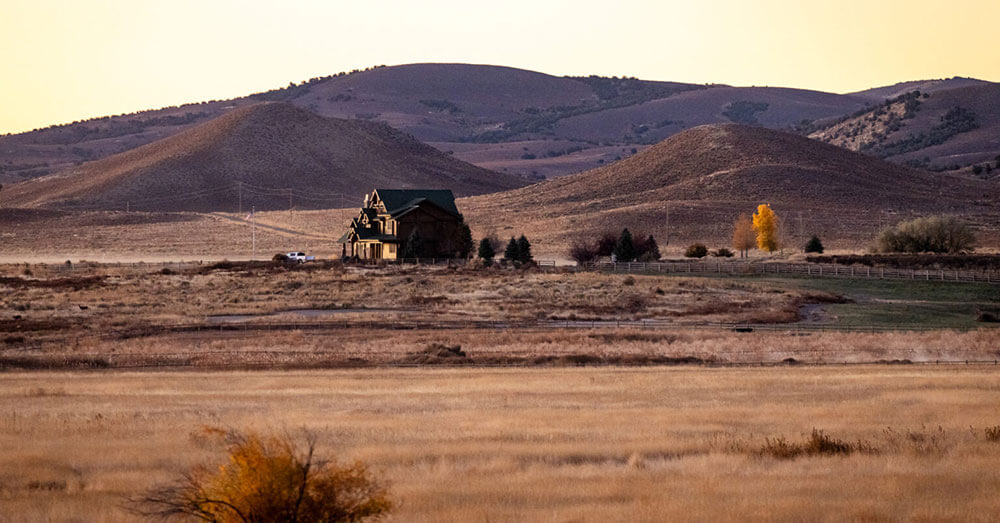
Ranch house on the eastern side of the Winecup Gamble Ranch property north of Wells on Friday, Oct. 20, 2023.
For public land managers and ranchers, it can be a logistical nightmare, with projects fragmented by alternating federal and private land ownership.
“We were really dealt a tough hand when the federal government decided they would divvy up the West in that checkerboard pattern,” said Wyatt Anthony, land manager for Kroenke Ranches, which includes Elko County’s 1.2 million-acre Winecup Gamble Ranch. “All of us have been left with a difficult situation.”
Billionaire Stan Kroenke, owner of the Winecup Gamble Ranch, as well as the Denver Nuggets and Los Angeles Rams and estimated by Forbes to be worth $14.6 billion, is proposing a potential land transfer with the federal government that would consolidate a substantial chunk of the checkerboarded land in northeastern Nevada.
Despite Kroenke’s backing, the project faces considerable hurdles, as it will need to either go through extensive administrative paperwork or congressional approval, and controversy surrounds the plan. Thus far, it has faced skepticism from hunting groups and local and state officials, with one state wildlife official saying the scope of land the ranch would receive is “out of proportion” to what the public would receive.
The proposed areas include some of northeastern Nevada’s most prized hunting grounds, including sizable herds of elk, antelope and mule deer, and the suggested transfer has drawn the ire of many who fear it could drastically alter access to public land.
The tentative plan introduced by Western Land Group, the company brokering the deal for Kroenke, would shift more than 230,000 acres of federal land to the ranch while transferring about 84,000 acres of ranchland to the Bureau of Land Management (BLM), the federal agency tasked with managing the nation’s federal lands, including roughly 48 million acres in Nevada.
Once a final proposal is drafted, it will be introduced to Congress for legislative approval rather than going through the BLM’s administrative process, according to Western Land Group. Understaffed, the BLM doesn’t have the bandwidth to accomplish such a project, Western Land Group said.
The transfer of public and private land would be the largest ever involving BLM land, according to Western Land Group. Kroenke’s representatives said the deal would remedy inefficiencies brought on by the fragmented ownership of the land. It also could permanently cement conservation easements and protect breeding grounds for species such as sage grouse and migration corridors for mule deer.
But local and state officials aren’t convinced.
“Our concerns have been pretty consistent through the process,” Nevada Department of Wildlife Deputy Director Caleb McAdoo told The Nevada Independent. “The challenge here is that it’s such a large landscape. We aren’t talking a chunk here or there — it’s whole mountain ranges and valleys. The scale is significant.”
Western Land Group originally planned to work through Congress as early as next year to initiate the transfer, but key Nevada lawmakers have not been approached on the subject, something at least one Nevada public land and law expert said should have happened by now. At the same time, the group’s tentative plans were made public through a series of meetings with state officials; now, instead of a clearcut plan to streamline property boundaries, the talks of consolidation have caused frustration and confusion in Elko County.
“There’s not a lot of details,” according to Curtis Moore, Elko County assistant manager and natural resources director. “Nobody’s really articulated what the public’s getting from this.”
