By Scott Sonner
Associated Press
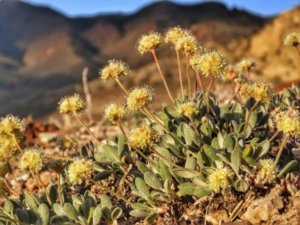
This photo provided by the Center for Biological Diversity, shows the rare desert wildflower Tiehm’s buckwheat in the Silver Peak Range about 120 miles southeast of Reno.
RENO — The rare Tiehm’s buckwheat stands less than a foot tall in Nevada’s rocky high desert, its thin, leafless stems adorned with tiny yellow flowers in spring.
To the Australian company that wants to mine lithium beneath the federal land where it grows, the perennial herb is a potential roadblock to a metal badly needed for electric vehicles and the global push to reduce greenhouse gases.
To environmentalists set on halting the open pit mine, it’s a precious species that exists nowhere else in the world.
And to plant ecologists, it’s a scientific challenge to try to grow the wildflower from seeds in a greenhouse.
Whose mission is a nobler shade of green depends on whom you ask.
The competing interests appeared to find some common ground earlier this year at the remote site about 200 miles southeast of Reno. Ioneer Ltd. has spent millions exploring the site, which it says is one of the world’s biggest undeveloped lithium-boron deposits.
But the Center for Biological Diversity withdrew its lawsuit against the U.S. Bureau of Land Management in January after Ioneer ended its exploration activities and agreed to provide the group notice before resuming any work at Rhyolite Ridge in rural Esmeralda County.
Still, Ioneer remains committed to the mine it says will produce 22,000 tons of the lithium carbonate needed for electric car batteries. It also says the mine will create 400 to 500 construction jobs and 300 to 400 operational jobs.
And environmentalists insist the legal battle is just beginning.
“The storm is brewing on the horizon,” said Patrick Donnelly, Nevada director of the Center for Biological Diversity.
The U.S. Fish and Wildlife Service is considering the center’s petition, filed in October, to add the flower to the federal list of endangered species. And the Nevada Division of Forestry announced this week it would soon start gathering public comments to help determine whether to take its own action to protect the plant.
“If you look at a map of the lithium deposits and a map of the buckwheat, there’s really no way to build the mine without wiping out the buckwheat,” Donnelly said. “We fully anticipate a fight for many years to come.”
The company acknowledges that the plant hasn’t been documented anywhere else in the world, but denies that the mine would lead to its extinction.
Company officials say they’ve been researching the plant since 2016, going to great lengths to ensure its protection and examining how it’s fared during previous mining operations at Rhyolite Ridge, near the small town of Tonopah, over the past 80 years.
They recently spent $60,000 for a yearlong study at the University of Nevada, Reno. Scientists there are growing hundreds of seedlings in a greenhouse to determine whether it’s feasible to transplant them into the wild to bolster the limited population, an estimated 43,000 plants covering a total of 21 acres.
“We have always been aware of the buckwheat. It didn’t come as a surprise,” Ioneer President Bernard Rowe told The Associated Press in a phone interview from Australia.
All site activity has been undertaken with the “protection of the buckwheat first and foremost in mind,” Rowe said. He added that the company’s mitigation strategy “will ensure protection, and, in fact, the expansion, of the buckwheat population.”
But Donnelly said the new research appears to be aimed at finding an alternative site “to keep the species alive so Ioneer could destroy its habitat.”
He acknowledged a difference between transplanting plants and growing them from seeds, but said it’s “beside the point, really.”
“A species is more than a set of genetic material. A species is inextricable from its habitat,” Donnelly said. “To allow a species’ habitat to be wiped out and put it someplace else is functionally allowing it to go extinct.”
Leave a Reply