By Howard Stutz
A legislative proposal allowing Nevada to operate a state lottery could slice into the revenue stream of Northern Nevada casino operator Truckee Gaming.
But it wouldn’t be a large chunk of the company’s cash flow, said CEO Ferenc Szony.
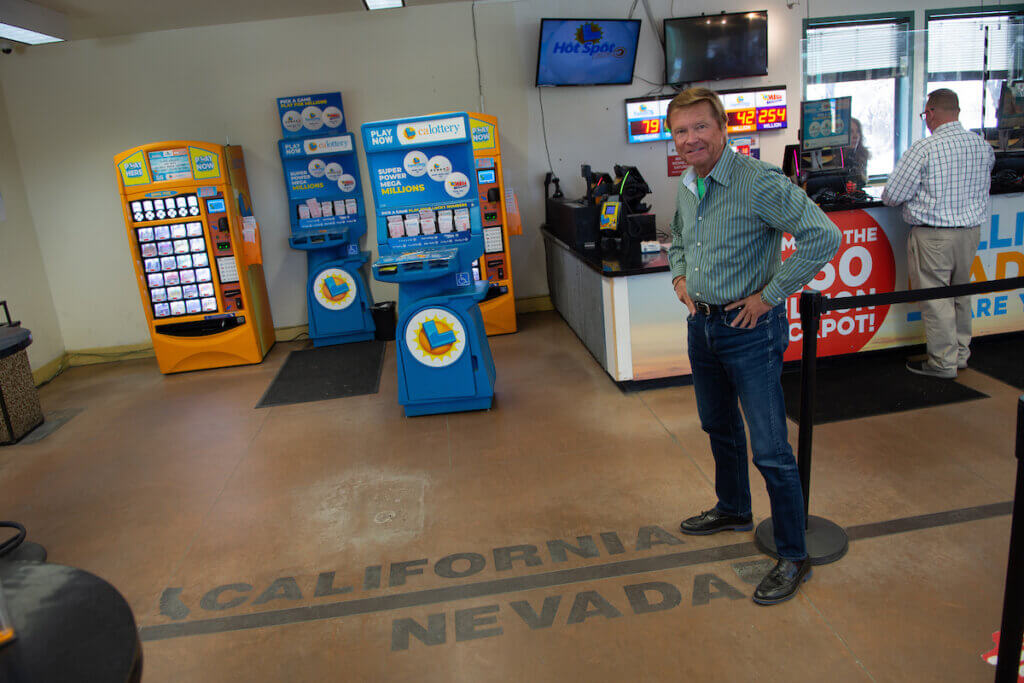
Truckee Gaming is a retailer licensed by the California Lottery to sell tickets from a store adjacent to the Gold Ranch Casino & RV Resort in Verdi. The store’s lottery terminals sit on the California side of the state line in Floriston. Truckee employees who manage the lottery store are considered California workers, subject to state income taxes.
“It’s a bit of an accounting nightmare for us,” Szony said.
But when the Powerball or other jackpots hit the nine-figure range, the lottery store is a busy place.
According to the California Lottery, Gold Ranch is the state’s second-largest seller of lottery tickets during multimillion-dollar jackpot events, trailing only the lottery store in Primm Valley. That outlet, operated by Las Vegas-based Affinity Gaming, is just across the state line from the company’s three Primm casinos. A spokeswoman for the lottery did not provide a revenue breakdown.
Szony considers the lottery store a marketing tool that draws customers to Truckee Gaming’s small Verdi casino, which has 250 slot machines, four food outlets, a gas station and a convenience store.
“We’re not making big bucks off the lottery, but it’s something fun and different to have,” Szony said.
Nevada’s relationship with the lottery could soon change. A proposed constitutional amendment sponsored by Assemblyman Cameron (C.H.) Miller (D-North Las Vegas), AJR5, would repeal the state’s 159-year-old constitutional ban on lotteries. Miller said in an interview with The Nevada Independent that revenue generated by a lottery would be directed toward youth mental health programs.
As with any constitutional amendment originating in the Legislature, AJR5 must pass two successive legislative sessions and then be approved by a simple majority of voters at the next general election before implementation. Miller’s proposal would have to pass the Assembly and Senate this year and in 2025 before voters could weigh in on the ballot question in 2026.
Gaming insiders suggested Nevadans wouldn’t see lottery tickets or scratch-off card sales from a Silver State retailer until 2027 or even 2028, given the amount of time needed to set up and implement rules and regulations on a future Nevada lottery.
Nevada is unique among the five states without a statewide lottery. Hawaii and Utah don’t have any forms of legal gambling, while Alabama and Alaska have only tribal casinos.
“We have a revenue issue and we need additional revenue sources,” Miller said. “It’s outdated for us not to have this revenue stream.”
Proposals to adopt a Nevada lottery have occasionally come up over the past decades, but have been easily swatted down by the state’s powerful casino industry. But with changing legislative and political dynamics, the industry is now on the defensive as it seeks to defeat the proposal and pour water on the idea that a lottery would be a revenue boon for the state.
Despite the opposition from the state’s casino industry, which produced a record $14.8 billion in gaming revenue in 2022, Miller said he is hopeful the resolution will be successful. He said legislative leaders told him “it was a reasonable time” to introduce the measure.
“This is a new day and new conversations can be had about a new future,” Miller said. “I think that is probably a window into how things have changed, and why we can potentially get it across the finish line. I just don’t know how hard or intense that opposition will be, because it’s a different time.”
Still, gaming industry leaders including Szony do not believe a Nevada lottery would provide the revenue stream proponents are touting.
“You can’t just do your own Nevada version. You have to tie into the national [multistate] lotteries,” Szony said. “The state really has to figure it out.”
He suggested a lottery won’t attract business from the tourist market but from state residents.
“A large portion of our state’s overall gaming comes from outside Nevada. A lottery is not going to benefit from that business,” Szony said.
Support and dissent
Nevada lawmakers last looked at a state lottery about a decade ago and, as in years past, the state’s casino industry helped ensure the measure never made it across the finish line.
Gaming consultant Brendan Bussmann believes it’s highly unlikely lawmakers would buck the state’s casino lobby and allow the question to reach voters.
“Opponents should be wary of that effort because it would likely pass on the ballot should it ever be presented to voters,” said Bussmann, managing partner of Las Vegas-based B2 Global.
Miller found support from Culinary Workers Local 226, which said in February it was on board with a Nevada lottery that would provide “sustainable funding to youth mental health and education.”
“And you know, if the Legislature doesn’t do their job, then we’ll make sure that we get somebody in there that does,” Culinary Secretary-Treasurer Ted Pappageorge said in an interview earlier this month.
Miller considered introducing a lottery resolution in 2021 in his freshman term, but it was suggested by colleagues it wouldn’t be a good idea.
“I was advised that may not be the best time to bring such a bill where there might be some significant opposition,” he said.
He received some backing for the proposal from Assembly Speaker Steve Yeager (D-Las Vegas) during Tuesday’s IndyTalks forum in Reno.
“Why are we funding California and Arizona education when we could keep that money here?” Yeager asked. “So I think there’s a responsible way to do it, and that’s why we’re starting the process.”
Assembly Minority Leader P.K. O’Neill (R-Carson City), however, said there wasn’t a need for a state lottery and said “it hasn’t delivered to the other states what they said it would, and suckered people into doing it.”
The Nevada Resort Association, which represents the state’s largest casino operators, said in a statement to The Nevada Independent that “lotteries cannot produce the vast array of meaningful careers found in Nevada’s resort industry.”
Resort Association President Virginia Valentine agreed with Miller that “more needs to be done today to address our youth’s mental health challenges.” However, she said “lotteries provide almost no employment and create no economic development or capital investment,” unlike the casino industry’s 385,000 jobs statewide. Gaming revenue in Nevada is taxed at 6.75 percent.
“The gaming industry is by far the state’s largest taxpayer, paying $2.1 billion in industry-specific taxes and fees in fiscal year 2022,” Valentine said. “Unlike states with lotteries, 35 percent of Nevada’s general fund revenue comes from the gaming and resort industry.”
Lottery efforts in Nevada
The resolution marks the second time in 12 years that Nevada lawmakers have had an opportunity to debate a constitutional change for a state lottery. Efforts in 2011 and 2015 never made it out of committee.
According to a 2012 UNLV research paper, there have been more than two dozen legislative attempts to implement a Nevada lottery, starting in 1887. That year, both legislative houses approved the establishment of a lottery corporation, but the bill was vetoed by then-Gov. Charles Stevenson.
State lawmakers passed another lottery proposal in 1899, but the measure was defeated in the 1901 session.
The issue remained quiet for almost 70 years until 1968, when a sweepstakes corporation qualified a lottery ballot initiative that was rejected by voters. Seven years later, two separate proposals were brought up in the Legislature, but both died in committee.
Since 1977, 24 proposed lottery measures have been introduced in the Legislature. All died in committee or were rejected by either the Assembly or Senate.
In 1990, Nevada voters approved a minor constitutional change allowing for the restricted operation of lotteries conducted by charitable or nonprofit organizations in the form of raffles or drawings on their own behalf.
